
What a Logan Resident Lookup Covers
A name search is a sorting task. The record type determines what can be confirmed and which office controls the result. Cache County property records may show parcel and owner fields. Utah election records may show public registration data. Xchange covers Utah district and justice court indexes. Vital sources are date- and relationship-limited. DOPL verifies a credential, while a business filing identifies an entity role. None is a universal list of Logan residents.
| Record | What it can confirm | Where | Access |
|---|---|---|---|
| Property / tax | Parcel, owner field, mailing and situs context | Cache CORE | Public tier with daily limit |
| Voter registration | Public registration fields and participation history | Cache Clerk / Utah election sources | Privacy rules apply |
| Court cases | Public party, case, events, documents, disposition | Utah Xchange | Billable; terminals may be free |
| Vital records | Older genealogy clues or eligible certificates | Utah Vital Records | Thresholds and proof |
| License / entity | Credential or filing role and status | Utah DOPL / business list | Role-specific |
Choose the smallest record set that fits the purpose. A family-history search may begin with the Cache birth index or an old directory. A credential question belongs with DOPL. A parcel clue belongs with CORE and GIS. A court name needs jurisdiction and case context. This separation keeps a Logan resident lookup from becoming a loose collection of same-name claims.
Anchor a Logan Name to a Record
Common names need more than a spelling match. Start with the full name, including a middle initial if known. Add a date, Logan or Cache jurisdiction, parcel, street, business role, or historical year. If the first result is a property field, check whether the line is a mailing address or a situs address. If it is a court result, read the county, court, case type, filing date, party code, and history. A party address may be absent or stale.
- Write down the name and the purpose of the search before opening a result.
- Use CORE or a lawful voter source only when an address or registration question is relevant.
- Search Xchange with the right jurisdiction, case type, name, and optional birth date or citation control.
- Compare a second source, such as a dated directory, business filing, or vital index, without exposing protected detail.
- Ask the custodian for a copy or correction when the result matters beyond a research lead.
A name that appears in two indexes is not automatically the same person. Two corroborating fields are stronger: the same case number and date, or the same parcel and legal description. Never use an old directory entry to assert a living person’s current location.
The DOPL name search page offers beginning-with or containing-name options and a profession filter.
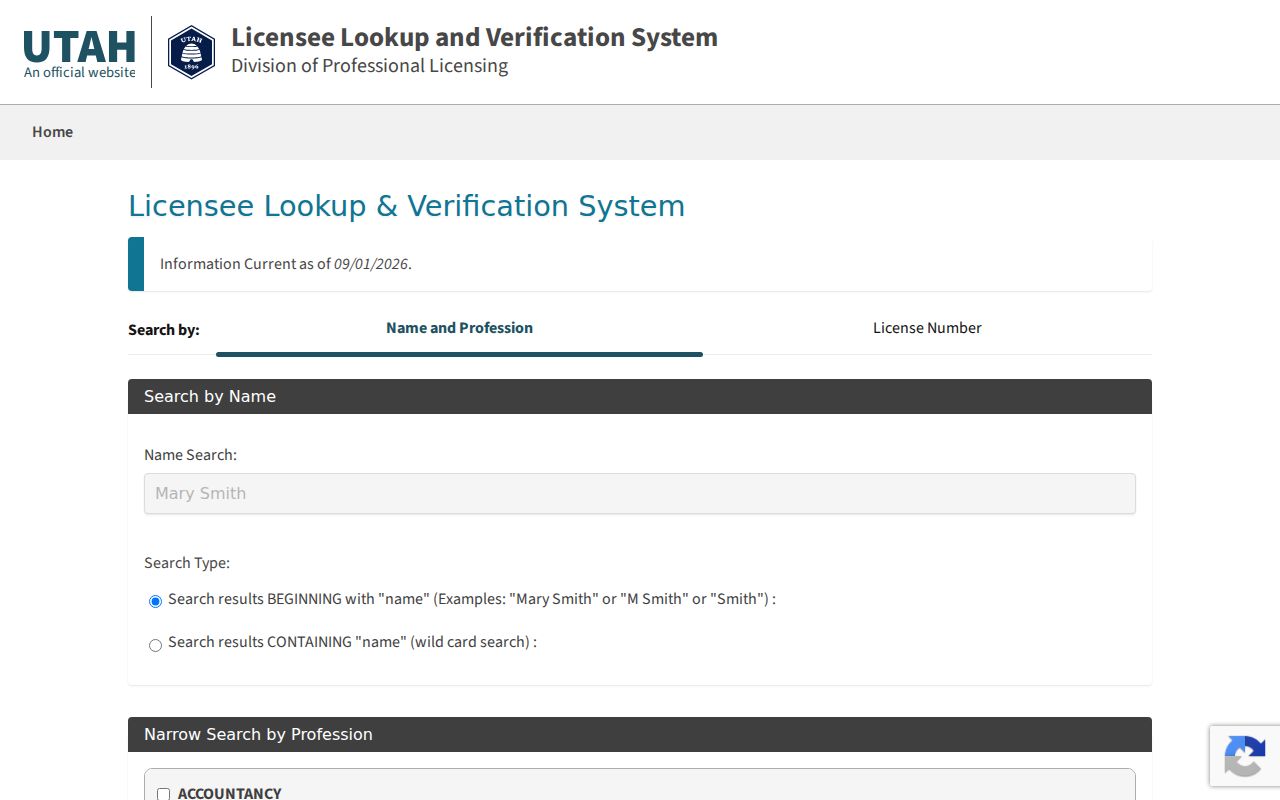
The screenshot is a credential-search example, not a Logan residence result. It shows why profession and license fields narrow a name without turning a license into a character judgment.
Utah Xchange Results for Logan Names
Utah Xchange searches district and justice court information. Its controls include jurisdiction, all cases or judgments, case number, last and first name, case type, statewide, county, or court scope, birth date, citation number, citation location, and date-range options. A first-name asterisk can work as a wildcard. The result row may show county, court, case type and number, filing date, name, date of birth when available, and party code. The history can show events, hearings, judgments, and document links.
| Result field | How to read it |
|---|---|
| Party | A person or entity attached to a case, not a finding of fault. |
| Claim or charge | An allegation or case issue that needs the full docket. |
| Disposition | The court’s recorded outcome, when shown. |
| Document | A filed item that may carry a separate purchase charge. |
| Address | Only present if filed, and it may be stale. |
Observed access pricing includes $10 registration, $0.20 per search, and $1 per document. A monthly option was listed at $25 setup plus $40 per month for 500 searches. Free public terminals are available at most district courthouses and the State Law Library. Xchange allows up to 500 results. Sealed, private, protected, juvenile, and expunged matters may not appear.
Note: The Cache District Court contact is 135 N 100 W, Logan, UT 84321, 435-750-1300; verify current access before visiting.
Federal Cases Are a Separate Logan Search
Federal cases do not merge into Utah Xchange. PACER and the District of Utah cover public federal dockets, with civil electronic coverage from July 1989 and criminal coverage from November 1992. Search by party name or case number, then keep the district, date, and case number beside the result. Sealed and Social Security matters are excluded. A federal party result should not be merged with a Cache County result just because the name looks alike.
Current research lists PACER at $0.10 per page, generally capped at $3 per document, with audio at $2.40 and a quarterly fee waiver at $30. Courthouse access and applicable fee exemptions are alternatives. Rates can change, so confirm the current PACER page when a paid document is needed.
Vital and Genealogy Clues for Logan
The Utah Archives Cache birth index covers Cache County Clerk registers from 1898–1905 and links to images. Utah did not require government birth records before 1898. The state’s birth guide says county clerks handled the 1898–1905 period, while the Department of Health began certificates in 1905. The WPA Soundex birth index adds a useful historical route for 1904–1924 and can catch variant spellings through its phonetic arrangement.
Death records are held by Utah Vital Records from 1905 forward, while State Archives records become public after 50 years. Marriage and divorce requests on the observed form cover 1978–2010, with limited marriage coverage from 2011 forward. The form asks for spouse names, place, date, relationship, proof, contact data, copy count, and payment. Observed fees include $18 for an initial marriage or divorce certified abstract, $30 for an initial death copy, and $10 for an additional same-day copy. Verify the current fee and eligibility.
An index is not a certified copy. Living-person birth and death details remain sensitive, and a genealogy hit is not proof of a current Logan residence.
Licenses, Entities, and Unclaimed Property
Utah DOPL’s license search has name and license-number tabs. A name search can begin with or contain a name and narrow by profession. Output can show profession, license name, type, number, status, issue and expiration dates, and possible discipline. Addresses and phones are generally exempt under DOPL’s stated privacy rule. A credential verifies a regulated record, not a person’s trustworthiness or home.
The Utah business list filters entity type, NAICS, ZIP, registration and expiration dates, and status. Output can include entity number, business name, address, status, renewal, applicant, principals, members, positions, and filed documents. A registered agent or principal is a filing role, not proof of residence. MyCash Utah is a free name search for last or business name, first name, and optional city or ZIP. Exact matches appear before similar ones, but a claim is not proof that someone lives in Logan. Use the state claim process to verify ownership.
Cache Jail and Corrections Limits
The current Cache Sheriff jail page says the roster is unavailable. Its general warning says the roster is unofficial, excludes state and federal inmates, may update no more than six times per hour, and has no booking photos since HB228. The page gives 435-755-1227 for contact. Do not replace that negative result with a guessed live list.
For a cleared incident or traffic report, the Sheriff records route uses a request and notarization form, email, or in-person request. Copies are listed at $10, active reports can be held until cleared, typical retention is five years with some records kept indefinitely, and unclaimed copies can be destroyed after 60 days. Utah DOC’s offender search covers people under UDC supervision, not county pretrial or unsentenced custody. VINE is a separate notification service. Custody status is especially time-sensitive and should be confirmed with the official agency.
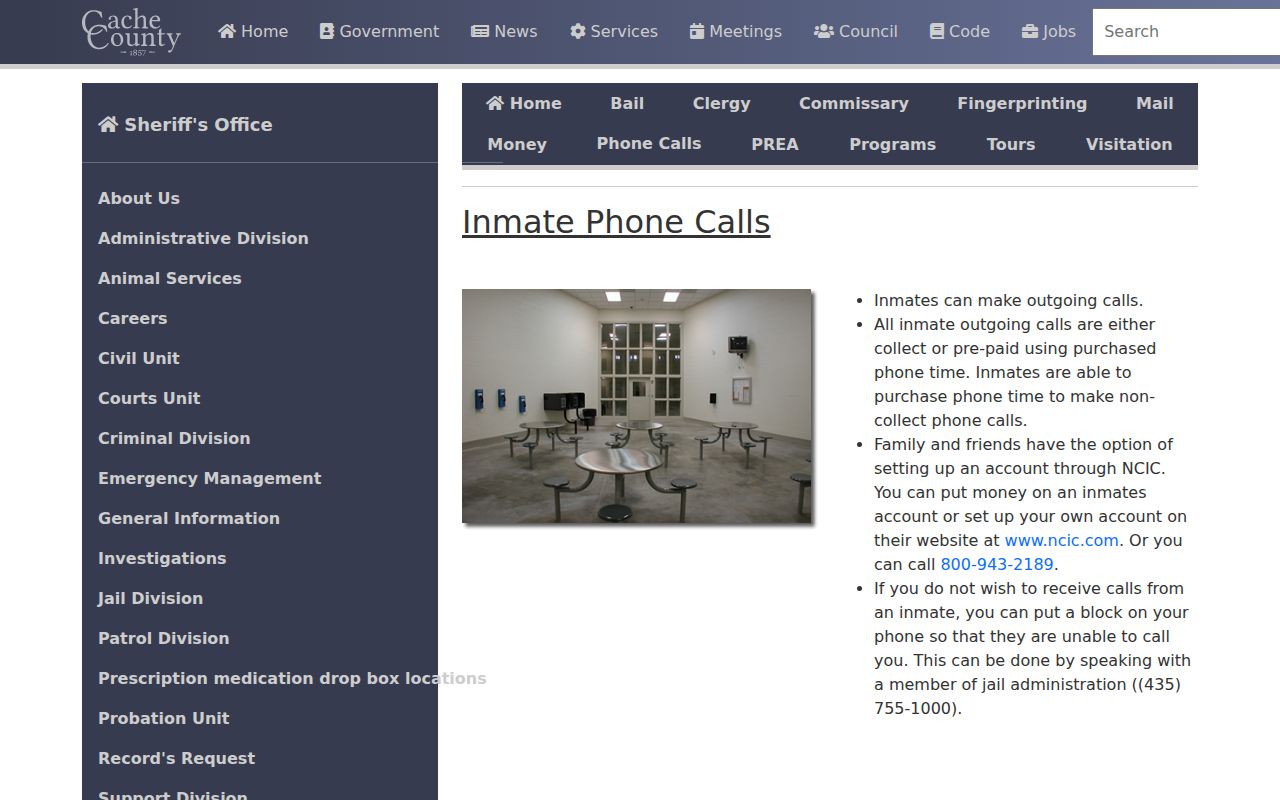
This capture documents an unavailable page, so the Logan resident lookup should direct readers to the phone and official alternatives rather than imply a searchable roster exists.
Legal Limits on a Resident Lookup
Utah public access is not permission to track or contact a person. Utah Code §76-5-106.5 addresses stalking as a repeated course of conduct connected to reasonable fear or emotional distress. Keep the search narrow, do not publish protected fields, and do not use an old address, party record, or directory line to claim a current home. The same caution applies to voter, vital, court, business, and custody records.
Lawful personal use. Use a Logan resident lookup for family history, archival work, civic understanding, a lawful personal record question, or another purpose supported by the custodian. Do not stalk, harass, intimidate, threaten, dox, or try to defeat Safe at Home or At-Risk protections.
Safe at Home protects actual addresses and related identifying information for eligible participants. Voter records can withhold or anonymize At-Risk people. Courts exclude sealed or protected matters. Absence from a public index is not proof that no record exists, and presence is not proof of wrongdoing. If the goal shifts to a street or historic household, use the site’s by-street or city-directory collection path instead of widening a person search.