
Logan City Directory Collections
The Utah City Directories collection reports 232 items and includes residents, streets, businesses, organizations, institutions, locations, and advertisements. Logan titles observed in the research run from 1913–14 through 1988, with gaps. The collection can include Logan and surrounding Cache communities, so read the title and geographic scope before treating a line as a Logan entry.
| Collection or edition | Years observed | Where held | Access |
|---|---|---|---|
| Early Logan volumes | 1913–14, 1915–16, 1917–18, 1920 | USU collection | Digitized scans; inspect page |
| Interwar Logan runs | 1924–25, 1926, 1929, 1930–31, 1935–36, 1937–38, 1939–40 | USU collection | PDF metadata and scans vary |
| Postwar volumes | 1946, 1949, 1953, 1955–56, 1958–59, 1961–66, 1968–71 | USU collection | Open each item |
| Later Logan titles | 1973–81, 1983–84, 1988 | USU collection | Verify each volume |
A year in the table means an observed title, not guaranteed coverage for every household. Some books include Hyde Park, Hyrum, Mendon, Millville, Providence, Smithfield, and Wellsville. The book’s own heading and street section decide whether a record belongs to Logan or the wider valley.
The Logan Library listing gives 285 N Main, Logan, UT 84321, phone 435-716-9123, and hours shown as Monday through Thursday 10–9, Friday 10–6, and Saturday 1–6. Verify current hours and holdings before a trip.
Logan Library’s institutional listing is the current starting point for local-history access.
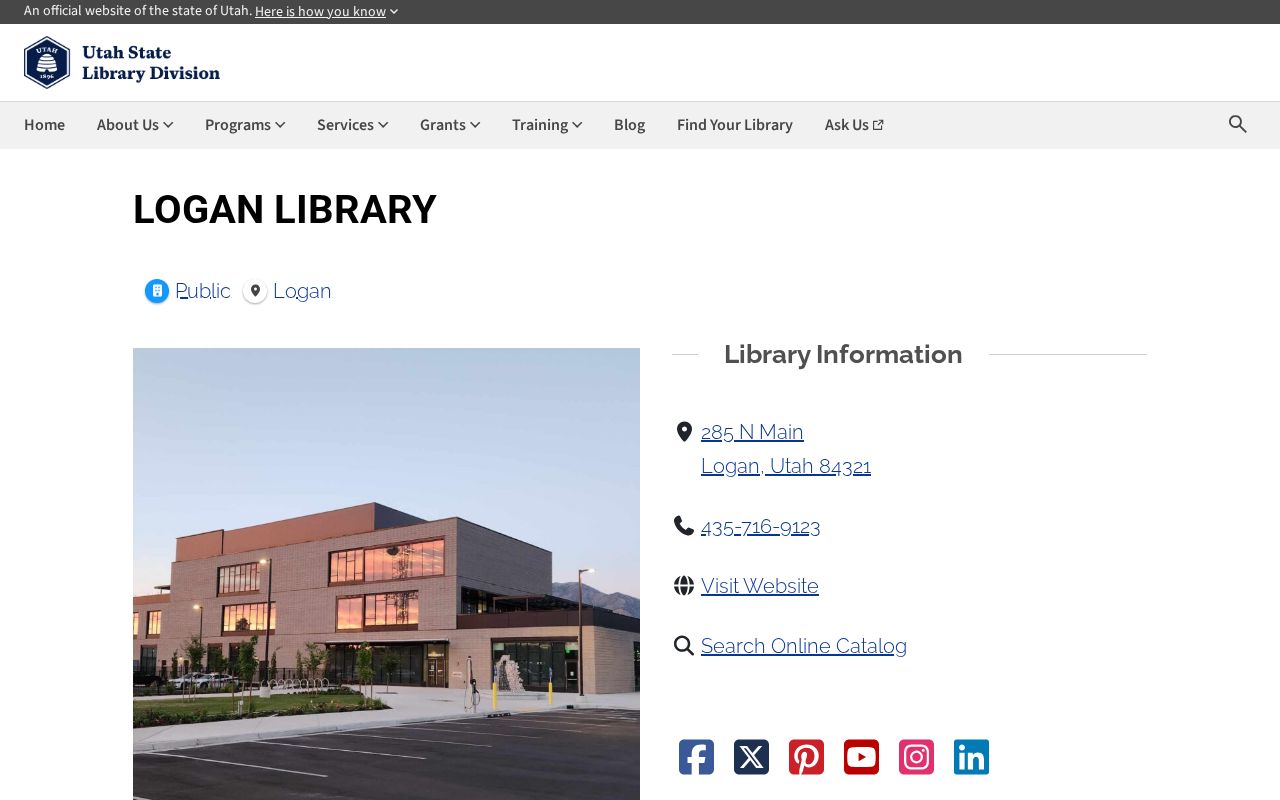
The library image connects a historical Logan city directory search to a real reference desk and its changing hours.
Four Ways Into a Logan Directory
The exact 1974 R.L. Polk item gives a clear map of how the book is arranged. Its title is “1974 Logan (Cache County, Utah) City Directory.” The contributor is Utah State Historical Society, the publisher is R.L. Polk & Co., and the item is a PDF with ARK s6peb3sb. It has four major sections, plus advertisements.
- Classified business directory: start with a trade or service category.
- Alphabetical directory: look under a surname, business, or organization.
- Street directory of householders and businesses: move from a street and number to an entry.
- Numerical telephone directory: work from a number when the edition includes one.
These routes can converge on one historical household, but they do not promise identical detail. One edition may show a phone or occupation while another omits it. Advertisements can identify a business location without identifying a resident. Read the page image, not just a catalog description.
Reading a Logan City Directory Entry
A useful entry inventory starts with the printed name and asks what else the edition actually supplies. Depending on the year and section, a Logan city directory may show:
- surname, given name, initials, or a business name;
- street name and house number in the household or street section;
- occupation, employer, or business category as printed then;
- spouse or household notation in some editions;
- telephone number in the numerical or alphabetical section;
- an owner or renter mark, if that edition uses one.
Do not fill a missing field from another source without labeling the change. A directory line is a historical artifact. A person can have moved, a street number can have changed, and a business can have closed after the edition was printed. Use the year and page number in notes.
- Criss-cross directory
- A reverse arrangement that begins with a street, number, or phone rather than only a surname.
- Householder index
- A street-oriented list of homes or occupants, not a guarantee that every household appears.
- Abbreviation key
- The edition’s explanation of short forms for occupations, relationships, or address notes.
- Index versus image
- An index locates a page; the scan supplies the printed context to check.
The 1915–16 Logan Directory Scan
The 1915–16 Logan City and Cache County Directory item is a concrete navigation example. The captured page is 15 of 226, and the parent record identifies R.L. Polk and the Utah State Historical Society contribution. This number describes that scan’s page count, not Logan’s population and not the number of resident records.
Use the item’s controls to learn how the book is organized. Do not invent a named person from catalog metadata when entry text has not been inspected. If a page is hard to read, compare the alphabetical and street sections, then confirm the street label against a map from the same era. A second dated source is more useful than a guess from blurred type.
Note: Logan directory years are observed collection holdings, not a claim that every year or household is represented.
Tracing a Logan Household Across Years
A city directory becomes more useful when each edition is treated as one point in a timeline. Start with the earliest known surname or street. Record the exact year, page, street spelling, house number, occupation, and household note. Then check the next available edition rather than assuming an annual change. A gap can reflect missing publication, an unscanned volume, a move, or a changed address style.
- Choose a year and search the alphabetical section for the family or business.
- Copy the street entry and occupation or phone detail exactly as printed.
- Check the street or numerical section for a second route to the same entry.
- Pair the edition with a census year when available, especially census material through 1930 noted by the Logan house-history guide.
- Use deeds, newspapers, Sanborn maps, and vital indexes to test a change.
A family-history trail can show that a name appeared in Logan during a particular year. It cannot, without a current source, establish where a living person is now.
Logan Library’s House-History Shelf
The Logan Library house-history guide joins older books to a deed chain, old appraisals, city permits, newspapers and obituaries, Sanborn maps, census material, local histories, and vital records. The guide is dated 2021, so staff routes and links should be checked. Library staff are research guides, not title attorneys. A deed answers a property-transfer question, while a directory answers a dated presence question.
The Utah Archives and USU Marriott collections are additional routes when a scan is not on the local shelf. The FamilySearch Center in North Logan, at 165 E 2200 N, is a genealogy resource with helpers, classes, and preservation equipment. It is not a Logan government office. Ask each repository about access, scan quality, and page navigation before promising a particular volume.
Maps Beside Logan’s Old Directories
Historical maps help resolve old street language. The Library of Congress set for Logan has 19 September 1900 Sanborn sheets. USU’s Sanborn collection includes Logan results and a 1930 sheet showing Wilson School and the Logan 7th Ward meeting house. Colors distinguish frame, brick, stone, iron, and adobe in the map legend. A map can show what stood near a block in a year, not who owned or occupied it.
Place the directory year, map year, and current GIS parcel together. If the old number does not fit the current parcel, consult the library guide’s advice on street-number changes, then check historical roads or parcels in Cache GIS. Keep the uncertainty visible. A modern address should not be back-filled into a 1915 entry without evidence.
Logan Newspapers and Local Memory
Newspapers can supply an obituary, business notice, legal notice, or community item that explains a change. USU’s local-history material notes that Cache Valley’s first newspaper, the Northern Light, began in May 1879 and was replaced by the Logan Leader. Logan Library hosts digitized local newspaper material, including a Cache American issue from 1946. These sources add context, but an obituary can expose family details, so use it for genealogy and archival work rather than contact targeting.
The Cache Valley Historical Society listing points to monthly lectures at Logan Library at 7 p.m. on the second Wednesday except July and August, plus an annual historic-homes tour. The inspected listing did not provide a detailed holdings catalog. Treat it as a local-history lead and verify current contact information.
What Logan City Directories Cannot Prove
A city directory is not a live resident lookup. It may omit children, unlisted numbers, or households outside the publisher’s reach. It can include a surrounding Cache town even when the title feels local. A street entry shows what was printed for that edition. It does not certify a current address, ownership, safety, or relationship.
Source discipline. Preserve edition year, page, publisher, section, and repository link. Use the custodian for a certified record and current Cache or Logan offices for present-day questions.
For current parcel and street work, follow the Logan by-street address workflow. For one-person cross-checking, a dated directory can be one corroborating source in a resident lookup, never the whole answer.