
Sources for Logan Address History
A search for previous residents needs sources that cover different eras. The Recorder and CORE follow transfers of property. City directories show people and businesses printed at a date. Census schedules can show a household. Sanborn maps show block and building context. Permits and newspapers can explain a change. No one source is complete, and a historical directory line does not certify a person’s present location.
| Source | Years or date range | Where held | What it shows |
|---|---|---|---|
| Cache Recorder / CORE | Current and older records; older indexing varies | Cache Recorder and CORE | Recorded parties, parcel and document trail |
| Logan city directories | Observed 1913–14 through 1988 | USU collection and Logan Library route | Householders, streets, businesses, occupations |
| Sanborn maps | 1900 Logan set; later USU sheets | LOC and USU collections | Buildings, materials, blocks and uses |
| Vital / newspaper sources | Historical coverage varies | Utah Archives, Vital Records, library | Family-history and obituary clues |
| Permits / appraisals | Local coverage varies | Logan City or Cache office | Work, tax, or improvement context |
The dated Logan house-history guide is the practical bridge across these sources. It begins with a current deed and works backward through grantors and grantees, then pairs property research with directories, newspapers, maps, census, and vital records.
Two history resources support the address timeline. The Cache birth image is a useful genealogy index route.
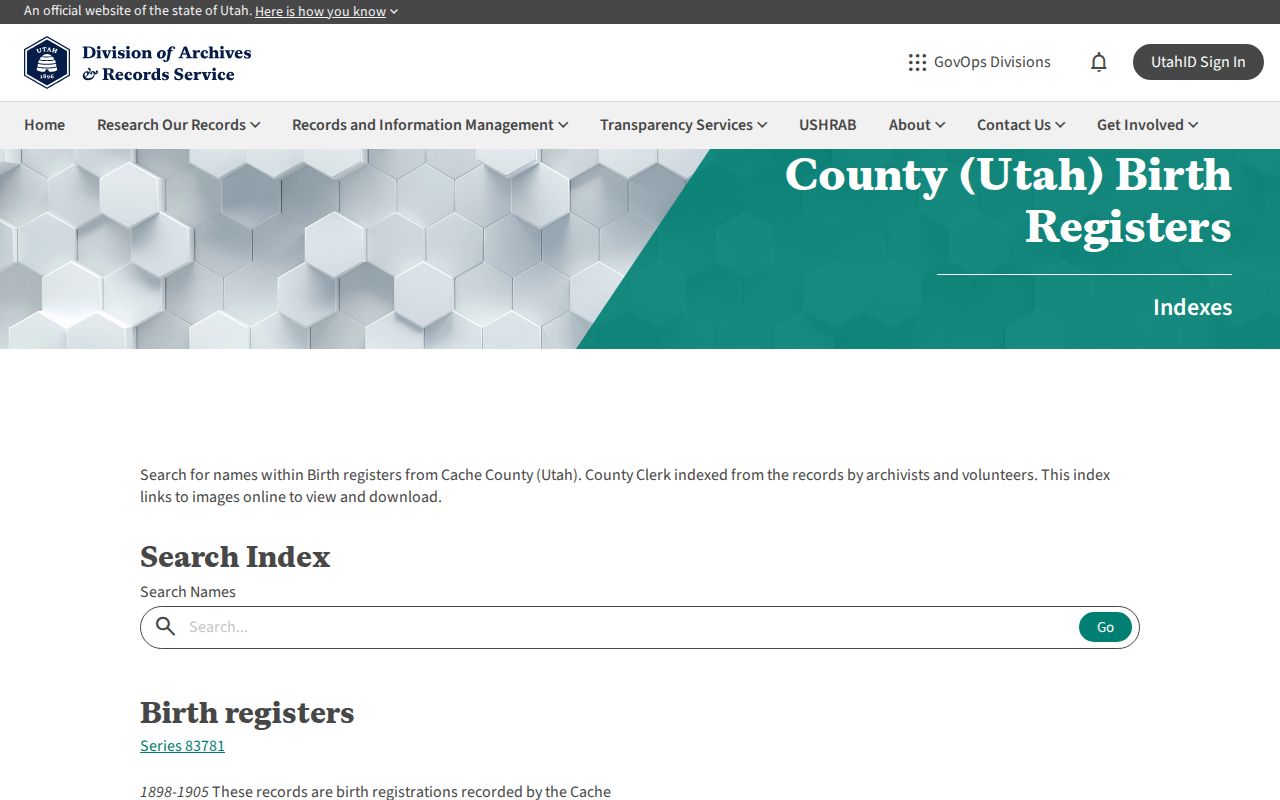
The image underscores that an archival index can help connect a family name to a dated record without proving where a living person resides.
Tracing Past Owners Through Cache Deeds
The deed chain starts with the current parcel and works backward. Use CORE or Cache GIS to identify the parcel, owner field, situs address, tax ID, and legal description. Then use the Cache Recorder index to locate the transfer that put the current owner on title. Search the seller or grantor as a prior grantee, match the legal description, and repeat. A parcel number and legal description are stronger joins than a street name alone.
- Save the current parcel ID and the legal description from the county sources.
- Find the latest transfer and record its entry number, date, parties, and book/page or image when available.
- Search the prior grantee as a grantor in the next earlier instrument.
- Compare the legal description and parcel context at each step.
- When online indexing ends, ask the Recorder about vault, book, microfilm, or copy access.
- Grantor
- The party transferring an interest in a recorded instrument.
- Grantee
- The party receiving that interest.
- Chain of title
- The linked history of transfers for one parcel.
- Legal description
- Deed or parcel wording that identifies land more precisely than a street label.
Cache says recorded documents are open for inspection and that plats show parcels, dimensions, tax ID, acreage, and current record owner. The Recorder can explain the index, but does not give title or boundary advice or call an index a title search. Exact copy fees should be confirmed with the office.
Cache’s 172,000-Document Imaging Milestone
A May 2023 Recorder notice reported more than 172,000 previously AEX-only documents added to CORE, including 171,522 book/page images grouped into documents and assigned entry numbers. Some material predates the entry-number system established June 1, 1888. A December 2024 county newsletter repeated the more-than-172,000 figure and described all-vault availability through CORE.
This is a digitization milestone, not a promise that every old page is fully searchable or that every prior resident appears in a current result. If a Logan address history runs before the online index, ask the Recorder about the county archive and the older books. Preserve the distinction between “not found online” and “does not exist.”
Note: The research found no separate public grantor-grantee form, so CORE and Recorder instructions are the verified starting points.
Previous Residents in Logan Directories
Owners are only part of the previous residents story. The Utah City Directories collection includes Logan titles observed from 1913–14 through 1988, with gaps. The 1974 R.L. Polk volume has alphabetical, street, numerical telephone, and classified business sections. A street section can show a householder or business at a dated number. A directory can include a renter or occupant who never owned the parcel.
Search the Logan city directory collections page for the book’s arrangement, then write down edition, section, page, street spelling, house number, occupation, phone, and any owner or renter mark. Do not fill a missing year with a guess. If a number has changed, compare old maps and the Library’s house-history guide before joining it to a modern parcel.
Pairing Logan Directories with Census Years
Census material can add household structure around a directory year, but it is not a live source. The Logan guide notes census research through 1930 through library access. A directory and census may differ because they were compiled at different dates, used different address forms, or captured different occupants. Use the disagreement as a prompt to inspect the page, not as a reason to select the result you prefer.
- Choose the directory edition nearest the household year in question.
- Copy the street, number, name, and occupation as printed.
- Find the closest available census schedule and compare household members and place.
- Check a newspaper, obituary, deed, or map for a move or number change.
- Label each fact with its source date and avoid a current-resident statement.
This pairing is useful for genealogy and house history. It can show how a household was described at two points in time. It cannot reveal protected living-person details or turn a historical name into a contact target.
Sanborn Maps for a Logan Block
The Library of Congress Logan collection has 19 sheets from September 1900. USU’s Sanborn results include a 1930 sheet with Wilson School and the Logan 7th Ward meeting house. The map legend uses color to distinguish frame, brick, stone, iron, and adobe. A sheet can show the building footprint, material, use, and nearby block context in its year.
A Sanborn map does not show a current owner, exact occupancy, legal parcel, or current building condition. Place it beside current GIS and a dated directory. If an old road or number is not obvious, Cache’s historical-road and historical-parcel layers may help explain the mismatch. Keep the original map year and sheet number in the research note.
Logan Library and Local History Sources
Logan Library’s listed location is 285 N Main, Logan, UT 84321, with phone 435-716-9123 and hours shown as Monday through Thursday 10–9, Friday 10–6, and Saturday 1–6. The guide identifies a local-history staff contact in its 2021 edition, but current staff should be verified. Ask about city directories, newspapers, local histories, maps, census databases, and the best way to read a scan.
The Cache Valley Historical Society listing points to monthly Logan Library lectures and an annual historic-homes tour, but the inspected listing did not provide a holdings catalog or current contact. The FamilySearch Center at 165 E 2200 N in North Logan offers genealogy help and preservation equipment. These are research routes, not substitutes for a recorded deed or a custodian’s certified copy.
The historical-society image points toward community memory while the recorded sources keep the address trail anchored to dates and documents.
Obituaries, Cemetery, and Probate Endpoints
An obituary or probate file can explain when a past resident left an address or identify a family connection. Use local newspapers, the Utah vital route, and Logan Library sources with care. The Logan City Cemetery appears in the parks plan as a 53-acre historical and geographic site, and a city report links cemetery deeds to Parks records and Cache Recorder or CORE. Research located no current official searchable interment database.
For a cemetery question, identify the cemetery, section, or plot if known, ask the city Parks or Cemetery office, and keep a deed, obituary, and family tree as separate evidence. A same-name directory entry does not prove burial. Probate and vital access may require identity, relationship, legitimate interest, or a copy fee. Never publish sensitive details about a living person.
Limits on Previous Residents Research
Previous residents research is for house history, genealogy, archival study, and a lawful personal record question. It is not a way to locate a living person. A deed names a recorded party. A tax notice has a mailing and situs distinction. A directory shows a dated listing. A census shows a household in its own enumeration. None should be rewritten as “current resident” without current, lawful confirmation.
Respect the boundary. Do not use old Logan addresses to stalk, harass, intimidate, threaten, dox, or expose a protected person. Safe at Home and At-Risk voter protections must not be bypassed, and a records officer is the route for corrections or restricted access.
The strongest address history is transparent about uncertainty. Keep the parcel, date, source, page, and confidence beside each fact. When the question shifts to who is near the address now, use the by-street or neighbors route rather than extending a historical name search.